Amazon.ca vs Amazon.com for KDP Publishers: What Actually Differs
The same book, published once through KDP, appears on every Amazon marketplace. That makes it easy to assume the marketplaces are interchangeable. They are not, and three of the differences will quietly corrupt your research if you do not know about them.
1. Best Sellers Rank does not mean the same thing twice
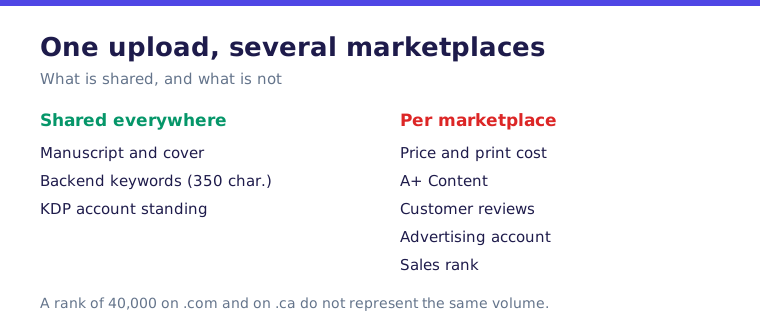
A rank of 40,000 on Amazon.com and a rank of 40,000 on Amazon.ca are not comparable numbers. Rank is a position within that marketplace's catalogue and that marketplace's sales volume. Amazon.ca is a far smaller store, so a given rank there represents far fewer copies.
The practical rule we now follow: pick the marketplace you are actually going to sell in, and do all rank research inside it. Cross-marketplace rank comparisons are noise.
2. Category node IDs are not transferable
When you find a category that looks reachable and note down its browse node, that identifier belongs to that marketplace only. Pasting a .com node into a .ca research tool does not resolve to the equivalent Canadian category — it either fails or returns something unrelated.
Categories also do not exist symmetrically. A niche with its own node on Amazon.com may be folded into a broader parent on Amazon.ca, or absent. If you are choosing categories per marketplace, you have to look them up per marketplace.
3. French-language pages break rank parsing
This one cost us real time. Amazon.ca serves pages in French depending on the account and locale, and Amazon.fr is French throughout. On those pages the product details block is labelled differently, so any script or tool expecting the English label finds nothing and reports no rank at all.
If you research French-language marketplaces, verify by hand on one known listing before trusting any batch result.
What does not differ
- The manuscript and cover. One upload, all marketplaces.
- The 350 characters of backend keywords. Set once, applied everywhere — which is a real constraint if you sell in two languages.
- Your KDP account standing. This matters more than publishers expect. Account-level trouble is not fenced to one marketplace.
What does differ that people miss
| Item | Behaviour |
|---|---|
| Print cost | Set per marketplace, in local currency, with its own printing rates |
| List price | Set per marketplace; a converted price is a choice, not a default worth accepting |
| A+ Content | Marketplace-specific. Building it on .com does not put it on .ca |
| Reviews | Do not always propagate; a .ca review may not appear on the .com listing |
| Advertising | Separate accounts per region. Losing one does not lose the other |
That last line is not theoretical for us. Our Canadian advertising account was suspended and the appeal refused; the North American account continued operating normally. The separation is real, in both directions.
Which one should you optimise for?
Pick the marketplace where your buyers are, then accept that you are optimising for one and merely present on the others. Trying to tune categories, price and keywords for two marketplaces simultaneously through a single set of fields produces a listing that fits neither.
For a French-language book, that means .ca and .fr research, in French, with rank verified by hand. For an English-language book, it means .com — and treating the .ca rank as decoration.
The 350 backend characters are the real bilingual problem
KDP gives you seven keyword fields, 350 characters in total, and they apply to every marketplace at once. There is no per-marketplace keyword set. If your book is French and you are also listed on Amazon.com, every French keyword you enter is dead weight on the American store, and every English one is dead weight on the French store.
There is no clean solution, only a choice. Ours: fill the 350 characters entirely in the language of the marketplace we actually expect sales from, and accept that the other stores get nothing. Splitting them in half produced a listing that surfaced for nothing in either language.
Price: the automatic conversion is a decision made for you
When you set a price on one marketplace, KDP offers converted prices for the others. Those defaults are a currency conversion, not a pricing decision. They ignore that each marketplace has its own printing rates, its own competitive price band, and its own psychological price points.
A converted price also lands on ugly numbers. A book priced to sit just under a round figure in one currency arrives at an arbitrary amount in another, sitting slightly above the band buyers expect. Setting each marketplace by hand costs about two minutes per title and is one of the few free levers left.
Where the marketplaces are genuinely connected
The separation is not total, and the place it breaks is the one that matters most: your account. Content decisions, metadata compliance and account standing are handled at the account level. A problem raised on one marketplace is a problem with your account, not with one listing.
This is why we treat the advertising separation as a lucky accident rather than a principle. Losing the Canadian advertising account did not touch the North American one — but we have never assumed the same protection would apply to publishing itself, and we would not test it.
A workable research routine
- Decide the primary marketplace first. Everything downstream depends on it.
- Do all rank and category research inside that marketplace, in its language, in a browser set to that locale.
- Verify one known listing by hand before trusting any batch of automated results. If a tool reports "no rank" on a book you know is selling, the tool is broken, not the book.
- Look up category nodes per marketplace. Never reuse an identifier across stores.
- Set price and, where possible, category by hand on the secondary marketplaces. Accept that they are secondary.