Changing Trim Size on KDP Creates a New ASIN: What That Costs You
We rebuilt a selling paperback from 6×9 to 8.5×11 to cut the print cost. The rebuild worked. What we had not fully priced in is that KDP treats a trim-size change as a different book — new ASIN, new listing, and none of the history carries across.
Why we wanted the bigger trim
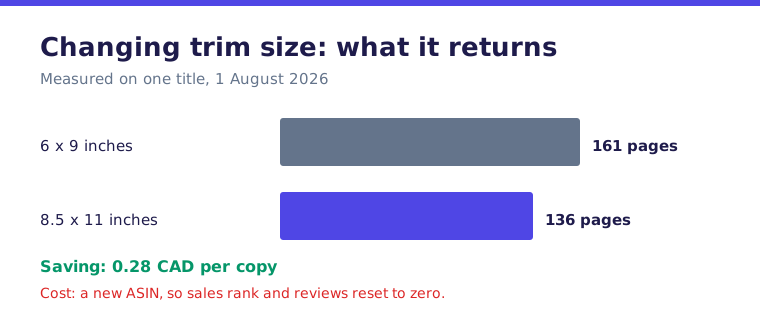
The original edition is a 6×9 paperback, 161 pages. Rebuilt at 8.5×11 with the same content, the same puzzles laid out for the wider page, it comes to 136 pages. Fewer pages at a larger trim means a lower print cost.
| Edition | Trim | Pages | Print cost effect |
|---|---|---|---|
| Original | 6×9 | 161 | baseline |
| Rebuild | 8.5×11 | 136 | −0.28 CAD per copy |
Twenty-eight cents. That is the entire financial upside, and it is worth stating plainly because it frames everything below.
The part that is not obvious: it is a new book
KDP does not let you change trim size on a live paperback. The size is fixed at the moment the edition is created. To publish the larger version you create a new paperback, which means:
- A new ASIN. A separate product page with its own URL.
- Sales rank resets. Whatever rank the original earned stays with the original.
- Reviews do not move. The new edition starts at zero, even if the old one had hundreds.
- Categories and keywords are re-entered, and the new listing has to earn its placement again.
- Any link you have published — in a description, on a site, in a video — still points at the old edition.
Do you keep both, or retire one?
Both editions can stay live. Amazon will show them as separate products unless you link them, and even linked they compete for the same buyer. The three realistic options:
| Option | Consequence |
|---|---|
| Keep both live | Buyer confusion; sales and reviews split across two pages |
| Unpublish the old | Existing rank and any reviews go dark; the new page starts cold |
| Keep old, treat new as a variant | Safest if the old edition has traction; the new one is an experiment, not a replacement |
We chose the third. The 6×9 edition is the one with sales history, so it remains the primary. The 8.5×11 is published as its own title and given its own runway.
When the trim change is the right call
The page-count saving is the weakest reason to do it. The strong reasons are about the reader:
- Legibility. A larger trim lets you set larger type without inflating the page count. For puzzle books, workbooks and anything aimed at readers who want big print, that is a product improvement, not a cost trick.
- Layout that was cramped. If content was being squeezed to fit 6×9, the wider page fixes a real defect.
- The book has no history to lose. If it is not selling and has no reviews, the new ASIN costs you nothing.
Before you rebuild, check the page count honestly
A bigger trim does not always reduce the page count. It does so only if you keep the type size and reflow. If you enlarge the type proportionally — which is often the actual goal — the page count can stay flat or rise, and the print cost with it. Build the interior, run it through the KDP previewer, and read the real page count before you commit.
What actually carries over, and what does not
| Asset | Moves to the new edition? |
|---|---|
| Manuscript and cover files | No — both must be rebuilt for the new trim |
| Backend keywords | No, but you can copy them across by hand |
| Categories | No — re-selected, and re-earned |
| Sales rank | No |
| Customer reviews | No |
| Description and A+ Content | No — A+ is rebuilt per ASIN and per marketplace |
| Author page association | Yes, once claimed |
The line that surprises publishers is the cover. A cover is built to an exact wrap size derived from trim, page count and paper type. Change any of the three and the wrap dimensions change. A 6×9 cover cannot be stretched to 8.5×11 — it is a new file, laid out again.
Do the spine calculation before you commit
Page count drives spine width, and spine width drives the cover wrap. Our rebuild dropped from 161 pages to 136, which narrows the spine and changes every dimension on the cover file. Publishers who rebuild the interior first and discover this afterwards end up producing the cover twice.
The two ways this goes wrong
Cannibalisation. Two live editions of the same book compete on the same search terms. Whatever discovery the original had earned is now split, and neither edition accumulates the sales velocity that drives rank. If you are going to publish both, be deliberate about which one you link to everywhere — site, description, ads.
Stale links. Every reference you have ever published points at the old ASIN: your site, your other books' back matter, any video or printed material. Those cannot all be updated, and the ones you miss send buyers to the edition you were trying to retire. We audited our own links after the rebuild and found several pointing at the wrong edition.
The honest summary
A trim-size change is a republication, not an edit. Judge it as one. If the reason is that the larger page genuinely serves the reader — bigger type, room the content needed — it is worth starting a new listing from zero. If the reason is a print-cost saving, run the number first. Ours was 0.28 CAD per copy, and no realistic sales volume makes that pay for a cold ASIN.
If you decide to go ahead
Treat it as a launch, because that is what it is. Copy the backend keywords across by hand rather than rewriting them from memory, re-select categories using current research rather than the ones you chose a year ago, and decide before publishing which of the two editions every link you control will point to. The new edition starts with no rank, no reviews and no history — the only thing you can give it is a listing that is correct on day one.