Blog / Sales
Eleven Titles, Zero Reviews: What Organic KDP Sales Look Like
Almost every published account of self-publishing income comes from someone with an audience, a backlist that already sells, or an ad budget. This one does not. It is an audit of eleven paperbacks published across roughly a year, with no reviews on any of them, no advertising running, and no mailing list. The distribution of results is the interesting part.
The numbers
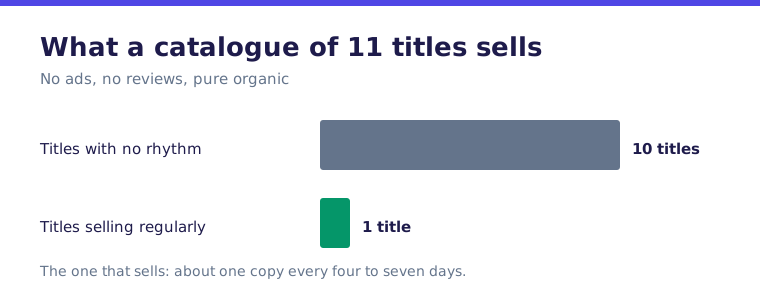
Audited across the full catalog in August 2026:
| Measure | Result |
|---|---|
| Titles published | 11 paperbacks |
| Titles with at least one review | 0 |
| Titles selling on a repeatable rhythm | 1 |
| Titles with no measurable sales | 9 |
| Rhythm of the one that sells | A copy every 4 to 7 days |
| Advertising spend during the measured period | None |
Two conclusions fall straight out of that table, and they point in opposite directions.
The encouraging one: a book with zero reviews can sell steadily. The idea that nothing moves until you have social proof is not what the data shows. One title sold on rhythm for months without a single review, without ads, and without any external traffic.
The sobering one: nine out of eleven sold nothing at all. Publishing more titles did not produce more sales. The catalog grew and the revenue did not, because the constraint was never the number of books.
What separated the one from the nine
The titles were produced to the same standard, in the same categories of book, by the same process. The difference was not quality. Three things distinguished the one that sold:
- It was in a language with far less competing supply. The one that sold was in French. The nine that did not were in English, competing against an enormously deeper catalog for the same shelf.
- Its title stated the format, the audience and the promise together, in the words a shopper would type. Not a clever title — a descriptive one.
- It answered a specific physical need, in this case large print, rather than a general interest. Buyers of that book were not browsing. They were solving something.
Note what is absent from that list: cover quality, interior design, page count, price. Those matter for conversion once a shopper is looking at the page. They do not appear to be what determined whether anyone arrived.
Language is a supply decision, not a translation decision
Publishing in a smaller language market is usually framed as reaching more readers. In practice its effect is on the other side of the equation: there are fewer books competing for the same search.
This has a real cost that is worth stating plainly. A smaller marketplace means fewer total shoppers, so the ceiling is lower. It also means your Best Sellers Rank numbers are not comparable to the ones other publishers quote, because rank measures position within a catalog, and the catalogs are different sizes.
And it is not automatic. Within our own results, one non-English marketplace produced steady sales while another produced essentially nothing across the same catalog. Language opens a door; it does not guarantee anyone walks through it.
How to read your own numbers, and what each one lags by
Most new publishers watch the wrong indicator and conclude too early. The three real signals, in order of speed:
| Signal | What it proves | Lag |
|---|---|---|
| Best Sellers Rank appears or improves | A copy sold. This is the fastest proof you have. | Hours |
| KDP dashboard units ordered | How many, and in which marketplace | About an hour |
| Royalty report | Money actually earned | Around 60 days |
Two practical notes. A book with no rank at all has not sold recently — absence of rank is information, not absence of information. And because royalties land roughly two months later, judging a title by your bank account means judging it on a picture of the past. Use rank for direction and royalties for confirmation.
What this suggests about where to spend your next month
If your own audit looks like ours — several titles, most of them silent — the instinct is to publish another book. Our data does not support that instinct. Nine silent titles is not a production problem. It is a demand and discovery problem, and a tenth title inherits it.
The more defensible sequence:
- Verify demand before producing. Search the phrasing a buyer would use and count what already exists. If nothing exists, that is usually a warning, not an opening.
- Fix the titles and descriptions of what you already published. The one book that sold did so because its title matched a real search. That is editable on the books that did not.
- Then, and only then, produce.
These figures come from one small catalog audited in August 2026 and are offered as a data point, not as a benchmark. Results depend on category, language, timing and a great deal of chance. Nothing here is a projection of income. See our corrections policy if you find an error here.
What the one title that sells has in common with nothing else
The single title moving copies is not the best-produced book in the catalogue, and it is not the one that received the most work. What separates it is that it is in a language and a niche where the search demand is real and the competing books are ordinary. Everything else in the catalogue targets terms where the existing books are better established.
That is an uncomfortable conclusion, because it says the outcome was decided at the topic-selection stage, before a single page was laid out. The production quality of the other ten did not fail. It was never the variable.
Zero reviews is not a small detail
Eleven titles, zero customer reviews. When we inspected sixteen competing books on page one of a commercial search term, every single one had reviews. Reviews act at the moment of the click — the shopper is comparing thumbnails and social proof, and an empty review count is a visible absence next to books showing dozens.
What we would tell someone starting now
- Spend the first week on demand, not production. Verify that people are searching for the thing, on the marketplace you will sell it on, in the language you will sell it in.
- Read the reviews of the books already winning. They tell you what the current books get wrong, which is the only opening a new title has.
- Expect the first year to be flat. Ten of our eleven titles produced no rhythm at all. That is not failure, it is the base rate.
- Do not answer flat sales by publishing more titles. We did, and eleven titles at zero is the same problem as one title at zero, repeated.