Does A+ Content Actually Sell More Books? What We Measured
A+ Content is free, it looks professional, and every KDP guide tells you to add it. We built it on four of our eleven titles and then checked whether the books with it behaved any differently from the books without it. They did not.
What we had to compare
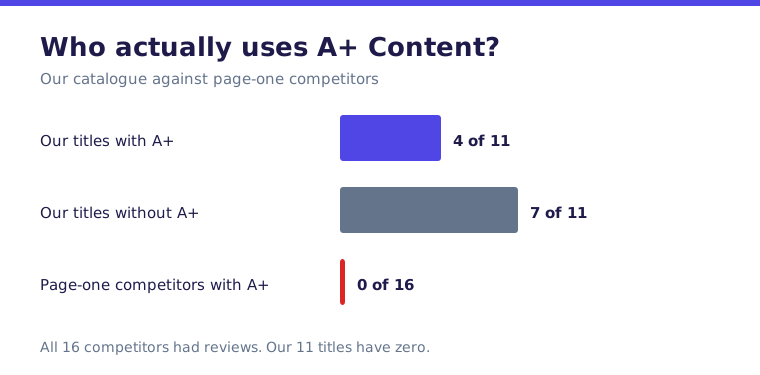
Eleven titles published under one KDP account, all low-content and puzzle books, spread across Amazon.com, Amazon.ca and Amazon.fr. Four of them carry a full A+ Content module set. Seven carry none. Same author name, same cover production process, same description style, same price band.
That is not a controlled experiment. The titles are in different categories and went live at different dates. But it is enough to answer the crude question: did the A+ titles pull away from the non-A+ titles?
The result: no separation
One title out of eleven sells on a regular rhythm — roughly one copy every four to seven days, entirely organic, no advertising. That title is a French-language word search book. It has no A+ Content. The four titles that do have A+ Content sit at the same place as the seven that do not: occasional sales, no rhythm.
The check that made this obvious
Before drawing any conclusion from our own eleven books, we looked at what winning books do. We pulled the first page of results for the main French-language keyword our selling title competes on and inspected all sixteen competing listings.
Not one. These are books ranking on page one of a commercial search term, and none of them bothered. Meanwhile all sixteen had something we did not: reviews. Our eleven titles have zero reviews between them.
Why A+ Content cannot do what people expect
A+ Content lives below the fold on the product page. To see it, a shopper must already have found your book, clicked into it, and scrolled past the buy box, the description and the related-products carousel. It is a conversion asset that only fires after the two hard steps — discovery and click — have already succeeded.
| Step | What decides it | Does A+ help? |
|---|---|---|
| Appearing in search | Keywords, categories, sales velocity | No |
| Getting the click | Cover, title, price, review count | No |
| Converting the visit | Description, reviews, look inside, A+ | Yes, marginally |
If your page gets almost no visits, improving conversion multiplies a number that is close to zero. That is the arithmetic that made our four A+ builds invisible.
When A+ Content is still worth building
It is free and it is permanent, so the cost is your time. It earns that time in three specific situations:
- You are already getting page views — from ads, from a backlist, from an existing audience. Then conversion is a real lever.
- Your book needs to be shown, not described — puzzle books, workbooks, coloring books, anything where an interior sample answers the buyer's real question. A+ is the only place on the page you fully control the images.
- You publish off-platform bonuses — A+ is the correct and compliant place to reference them, unlike the description.
What it is not: a fix for a book nobody finds.
What we would do differently
We built A+ Content on four titles before we had a single review on any of them. In hindsight that was the wrong order. Reviews affect the click — the step before A+ even loads — and every page-one competitor we inspected had them.
If we were starting again with eleven titles and limited hours, we would put A+ on the one title that already sells, and spend the rest of the time on discovery for the other ten.
What we could not measure, and why it matters
We can see that our A+ titles did not pull away from our non-A+ titles. We cannot see conversion rate. KDP does not report page views or a view-to-purchase ratio for a book, so there is no way to isolate the one thing A+ is supposed to affect.
That cuts both ways, and we want to be straight about it: A+ could be improving conversion on our four titles and we would not be able to detect it, because the traffic underneath is too small for any conversion gain to show up as sales. What we can say with confidence is narrower and still useful — A+ did not create demand where there was none.
The comparison that would actually settle it
The clean test exists, and it needs one thing we do not have: a title receiving steady, measurable traffic. Send a known volume of visits to a listing without A+, record the sales, add A+, send a comparable volume, record again. Advertising is the normal way to buy that traffic.
We cannot run it. Our Canadian advertising account was suspended and the appeal refused, which removed the obvious source of controlled traffic for the marketplace where our only selling title lives. Until that changes, any claim we make about A+ and conversion would be inference dressed up as measurement.
What the page-one competitors did have
Since none of the sixteen had A+ Content, the more useful question is what they had in common instead. Two things, on all sixteen:
- Reviews. Every one of them. This is the asset our catalogue is missing entirely — eleven titles, zero reviews.
- A cover that reads at thumbnail size. Title legible, subject obvious, no detail that only survives at full resolution.
Both act before the click. A+ acts after. If you are choosing where to spend the next four hours, that ordering is the whole answer.
A practical rule
For low-content and puzzle books the second condition is often genuinely met — a buyer wants to see the grid size and the print size, and no description conveys that. That is a real reason. "Every guide says to add it" is not.