An Amazon Ads Campaign at Zero Impressions on a KDP Paperback
We launched an automatic Sponsored Products campaign on one of our paperbacks and the console still reported 0 impressions after 4 consecutive days — not a low click rate, not expensive clicks, simply nothing recorded. Amazon notes that advertising data can take several days to appear, so the first thing to establish is whether you are looking at no delivery or at no reporting yet. This is what we found when we went looking, and what we still cannot prove.
What the Amazon Ads campaign actually was
The title is a large-print word search paperback listed at 16.99 USD, 161 pages, 6×9. The campaign was launched on August 13, 2026 at 5 USD per day, United States only, automatic targeting, one ad group. Automatic targeting was a deliberate choice: an exact-match campaign only ever reports back the keywords you typed into it, so it cannot tell you what shoppers really search. If the point of a first campaign is to learn the vocabulary of your own market, automatic or broad is the only setting that answers the question.
Everything about the setup looked ordinary. The budget was not exhausted, because nothing was spent. The campaign showed as delivering. There were no policy notices, no rejected creative, no suspended payment method. The daily report simply read zero across every column, four days running, which is a failure mode that gives you nothing to react to.
Why zero impressions on a KDP paperback differs from zero sales
It is worth separating these clearly, because publishers routinely treat them as one complaint. Zero sales with impressions and clicks is a conversion problem: people are seeing the book and choosing not to buy it, which points at the cover, the price, the reviews, or the sample. Zero impressions is upstream of all of that. The advertisement never entered an auction, so no shopper has ever seen the book, and nothing about the listing has been tested yet.
That distinction matters because the two problems have opposite remedies. The conversion problem is fixed on the product page. The impressions problem is fixed inside the campaign settings, and no amount of work on the cover will move it. Four days of zero is not a soft signal that the market is uninterested. It is the campaign telling you it never got to ask.
The bid export identified the leading hypothesis
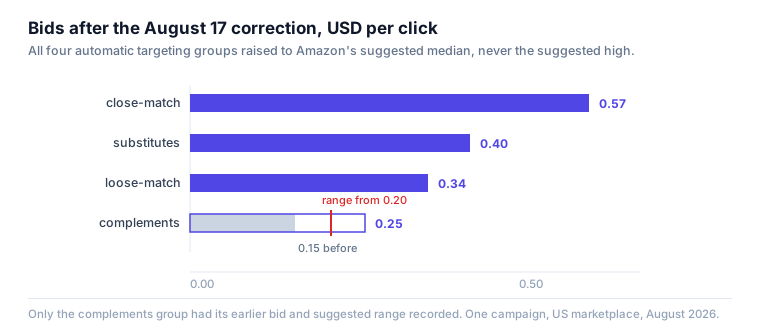
The console interface shows a campaign-level summary that hid the problem entirely. What exposed it was downloading the Sponsored Products Target report, which lists every targeting group with its own bid alongside Amazon's suggested range for that group. Read side by side, 3 of the 4 groups were bidding at or below the lower bound of their suggested range. The clearest case was the complements group at 0.15 USD against a lower bound of 0.20 USD.
It is tempting to call that lower bound a floor, and we did at first. It is not one. Amazon describes the suggested range as being derived from the bids of similar ads that recently won impressions — it is a competitiveness indicator, not an eligibility threshold, and no warning is shown because no rule was broken. A bid below the range can make an ad less competitive; on its own it does not prove why nothing served. What the export gave us was the leading hypothesis, and the useful habit behind it: when a campaign delivers nothing, do not study the campaign screen, export the target-level report and compare each bid against its own suggested range. See Amazon Ads on how bidding works, checked August 26, 2026.
Dynamic bidding made a low bid lower
The second half of the explanation was the bidding strategy. The campaign was set to dynamic bids, down only, which is the default and which sounds prudent. It lowers your bid in real time when Amazon estimates a sale is unlikely from that placement.
Here we move from observation to hypothesis, and it should be labelled as such. Amazon states only that the strategy can lower a bid when a conversion looks less likely; it does not publish which signals feed that estimate, how often a reduction is applied, or what a complete absence of reviews does to it. We cannot show from any report that our bids were reduced, or by how much. What we can say is the arithmetic: any downward adjustment applied to a bid already below its suggested range moves it further below, never closer. That is why we changed the setting — not because we had measured its effect, but because it could only work against us here.
What we changed on August 17
Three changes went in together, which does mean we cannot attribute the outcome to any one of them individually.
- Bidding strategy switched from dynamic down-only to fixed bids.
- All four group bids raised to Amazon's suggested median: close-match 0.57, substitutes 0.40, loose-match 0.34, complements 0.25 USD.
- Campaign end date pushed to September 8, 2026, to leave a measurable window.
The suggested median was chosen deliberately over the suggested high, for one reason only: the median stayed under the maximum cost per click this title can actually carry, and the high did not. That is the rule worth taking away — never bid above the sustainable CPC you calculate for the specific book. On another title with a fatter margin, the high bid might be perfectly reasonable.
The arithmetic that sets the ceiling on your bid
Before raising any bid it is worth knowing what a click can be worth on a paperback, because print books have thin margins and the answer is often smaller than the suggested range implies.
Royalty = (16.99 × 0.60) − 2.93 = 7.26 USD per copy.
Break-even ACOS = 7.26 / 16.99 = 42.7 %.
Maximum sustainable cost per click at an 8 % conversion rate = 0.58 USD. At 5 % = 0.36 USD.
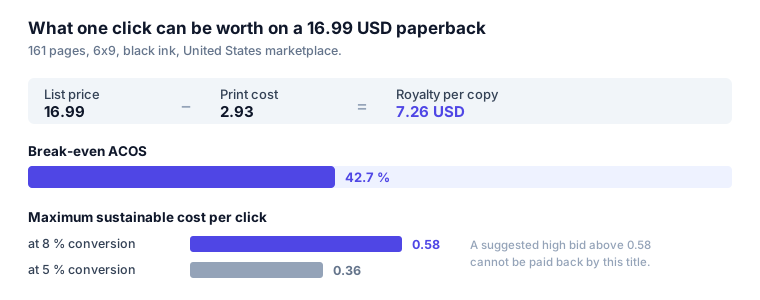
That 0.58 USD ceiling is the honest upper limit, and it assumes a conversion rate that a book with no reviews is unlikely to reach. It is also the reason the close-match bid of 0.57 USD is right at the edge of what the title can carry. Anyone quoting a suggested high bid of one to two dollars on a 16.99 USD paperback is quoting a number the product cannot pay back.
If you want the underlying cost figures for your own trim size and page count, they are set out in our note on KDP print costs and royalties. The royalty, not the list price, is what your advertising has to fit inside.
The constraint we could not fix with money
All of the above is a mechanical problem with a mechanical solution. The larger constraint on this campaign is not mechanical: across the catalogue we have 0 customer reviews across 11 published titles. Amazon's estimate of conversion likelihood is not arbitrary, and a listing with no social proof is a genuinely weaker bet in an auction.
So we hold this expectation openly: raising the bids should restore impressions, and it should not be expected to produce profitable sales. On this niche, at these margins, advertising is at best a break-even instrument. Its value is the search-term data it returns and any lagging effect on sales rank, not direct profit. A publisher who buys advertising expecting margin on a 16.99 USD paperback with no reviews has mispriced the exercise before the first click.
Other causes to rule out before you raise a bid
The bid is the interesting answer, which is exactly why it should not be the first one. Before touching a single figure, work down this list — several of these cost nothing to check and one of them will save you from raising a bid on a campaign that was never eligible to serve.
- Reporting delay. Advertising data can take days to populate. A zero on day two is not a finding.
- Ad or campaign status. Ads under review, paused, ended, or scheduled to start later all serve nothing.
- Retail availability. If the book is out of stock, unavailable, or not the featured offer on that marketplace, its ads stop.
- Marketplace and targeting mismatch. An automatic campaign needs the listing to be indexed for something; a brand-new title may have almost nothing to match against.
- Billing. A declined payment method suspends delivery, and this is announced quietly.
- Budget. A budget exhausted early, or set below what a single click costs, ends the day before it starts.
- Bid competitiveness. Only now, and only against each group’s own suggested range.
Where the settings actually live
Two of these controls are not on the same screen, which cost us time. The bidding strategy is at campaign level, under Campaign settings. The individual group bids are one level down, under Ad groups → your group name → Targeting. Changing the strategy without then revisiting the group bids leaves the original problem in place, since fixed bids simply hold a below-floor bid steady instead of lowering it.
One further practical note: on a mobile browser the Bid column sits off the right edge of the targeting table and requires horizontal scrolling within the table itself. It is easy to conclude the column is absent and to assume the bids cannot be edited from a phone.
A checklist when Amazon Ads serves nothing on a KDP book
- Confirm the campaign is delivering and the payment method is valid. Rule out the boring causes first.
- Download the Sponsored Products Target report. Do not rely on the campaign summary screen.
- Compare every group bid against its own suggested range. A bid at or below the lower bound is a plausible cause, not a proven one.
- Check the bidding strategy. Down-only on a title without conversion history compounds a low bid.
- Calculate your royalty and break-even cost per click before raising anything, so you know your ceiling.
- Raise only as far as the sustainable CPC you calculated for that title allows, and give it a defined window before judging.
Scope and limits of this report
This is a diagnosis in progress, not a solved case, and the distinction matters. This is one automatic campaign, on one paperback, in the United States marketplace, observed between August 13 and August 17, 2026. Three corrective changes were made on the same day, so even a good result afterwards could not tell us which one mattered. We have not published an outcome because we do not have one: the search-term report is due after the campaign window closes on September 8, 2026, and we will publish what it shows whether or not it is flattering. Amazon does not publish auction mechanics, and the suggested ranges in the console move over time, so every figure here is a snapshot. What is measured: the bids, the suggested ranges, the dates, and the margin arithmetic, which uses Amazon’s published printing cost formula. What is hypothesis: that bidding below the suggested range explains the silence. Nothing here should be read as a claim about why Amazon made any particular decision.