Blog / Advertising
Amazon Ads Account Suspension: What It Costs a Publisher
Most advice about Amazon Ads assumes you will always have an account. That assumption is worth examining, because losing one is quiet, fast, and in at least some cases permanent. This is what a suspension and a refused appeal actually looked like for a small publisher in 2026 - including the uncomfortable part, which is that Amazon never said why.
Amazon does not tell you why
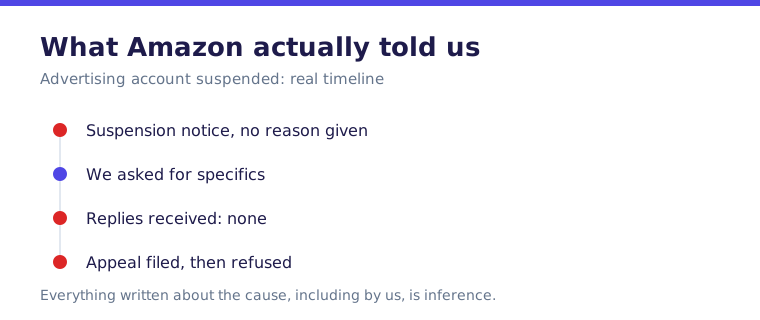
Start with the part that shapes everything else: the notice does not contain a reason. It states that the account has been suspended and refers to policy in general terms. It does not name the campaign, the charge, the setting or the event that caused it.
We asked for specifics. Months later, we still have none. That is not unusual, and it is why almost everything written about the causes of Amazon Ads suspensions — including what follows — is inference rather than confirmation. Treat it accordingly.
The one thing that coincided: a declined prepaid card
Amazon Ads bills after the fact. You spend first, and Amazon collects afterward, which is why the platform cares about your payment method more than a normal retailer would.
In our case the account was funded by a reloadable prepaid card. That card was declined when Amazon attempted to collect, and the suspension followed. We cannot prove the decline caused the suspension — Amazon never confirmed a reason, and the two events could in principle be unrelated. What we can say is that they coincided, and that the sequence is consistent with how a post-paid billing system would be expected to behave.
That is thin evidence to build a rule on, but the rule costs nothing to follow: if you are running Amazon Ads on a prepaid, reloadable or virtual card, move it to a bank-issued credit card in your own name at your own billing address. Two minutes now against a risk you cannot quantify and may not be able to reverse.
What the appeal actually is
The word "appeal" sets the wrong expectation. There is no hearing, no case number you can call about, and no human you can reach who is empowered to reverse the decision. You submit a form, you receive an acknowledgment, and some weeks later you receive a decision that is one paragraph long.
In our case the decision was a refusal, described as final, with no stated reason beyond a reference to the original policy. There was no second level of appeal offered and no route to escalate.
Plan on that outcome rather than the optimistic one. If your marketing plan for a title depends on ads being restored, the plan needs a version that does not.
The decision that turns a bad situation into a disaster
The obvious move after a refused appeal is to open a new advertising account. Do not do this.
Your Amazon Ads account and your KDP account are linked by the same identity signals — name, address, bank details, tax information, device and network. Creating a second advertising account after a suspension is the textbook definition of circumventing an enforcement action, and the enforcement that follows does not necessarily stop at the advertising account.
The asymmetry is brutal. A replacement ads account might recover a few hundred dollars of monthly spend capability. Losing the KDP account means losing every published title, every review, every ranking, and the royalty stream from all of it. It is not a rational bet at any odds.
Advertising is per-marketplace, and that is the survivable part
Amazon Ads accounts are regional. A suspension on one marketplace does not automatically suspend the others, which means a publisher who loses one country can often still advertise elsewhere.
In our case the Canadian account was lost and the US account remained active and in good standing. That matters more than it sounds, because for most English-language self-published titles the US marketplace is where the volume is anyway. The suspension removed access to a small market and left the large one intact.
Two practical consequences:
- Test in the marketplace you can afford to lose, only if you have to. If you must experiment with billing or campaign structure, do not do it in your primary market.
- Verify your payment method separately on each marketplace. They do not share billing configuration, so a card you fixed in one place may still be wrong in another.
Operating without ads in one market
Losing paid access in a market does not end the market, but it does change what you can learn from it. Ads are the fastest way to discover which search terms actually convert; without them you are reading rank movement and inferring.
What still works:
| Signal | What it tells you | Lag |
|---|---|---|
| Best Sellers Rank movement | A sale occurred | Hours |
| KDP dashboard units | How many, which marketplace | About an hour |
| Royalty reports | Confirmed revenue | Around 60 days |
| Search term reports from another marketplace | Language and intent that convert | Weekly |
That last row is the underused one. Search term data from a marketplace where you can still advertise is transferable insight about buyer language, even if the specific keywords and competition differ. It will not give you the local terms, but it will tell you what phrasing readers use to describe the problem your book solves.
A checklist worth running today
- Your Amazon Ads billing method is a bank-issued credit card, not prepaid, not reloadable, not virtual.
- The billing name and address match the ones on your KDP account exactly.
- You have checked the payment method on every marketplace where you advertise, not just the primary one.
- Your launch plan for the next title does not assume ads will be available.
- You have never opened, and will never open, a second advertising account after an enforcement action.
This describes one publisher's experience with a suspension and appeal concluded in August 2026 on the Canadian marketplace. Amazon does not publish its enforcement criteria and outcomes vary. Nothing here is legal advice, and it should not be read as a prediction of how Amazon will treat any other account. See our corrections policy if you find an error here.
The move that turns a lost account into a lost business
The obvious response to a suspended advertising account is to open a new one. Do not.
Weigh the two losses honestly. Losing an advertising account costs you a channel. Losing a KDP account costs you the catalogue, the royalties and the ability to publish under that identity at all. There is no advertising outcome worth putting the second one at risk for.
What still works after the account is gone
The separation between regional advertising accounts is real: ours was suspended in one region and continued operating normally in another. That is not a loophole, it is how the accounts are structured — but it means the practical answer after a suspension is to work the marketplace you still have access to, not to reconstruct access to the one you lost.
Beyond that, everything that made books discoverable before advertising still functions: backend keywords, category fit, the cover at thumbnail size, and reviews. Those were always the larger levers. A suspension is a good moment to notice how much weight had been resting on paid traffic that was never converting anyway.