We Audited Our KDP Backend Keyword Boxes: 210 of 350 Characters Used
KDP gives you seven keyword fields of fifty characters each. We assumed ours were reasonably full, because they had been written from a real market study. Then we counted. One listing was using 210 of 350 characters, and a large share of those repeated words that were already in the title.
Counting the KDP backend keyword boxes on a live listing
The audit was done on July 28, 2026, on a French-language word search paperback that was, at the time, the only title in the catalogue selling on any regular rhythm. It was not a neglected listing. The keywords had been chosen deliberately from research, not typed in a hurry at upload.
The count still came to 210 characters across the seven boxes. That is 140 characters of indexing space left empty, or forty percent of the field. Rewritten with the three rules below, the same listing came to 333 of 350. Nothing was removed from the book, nothing was repriced, and no advertising was involved. It is the cheapest correction available on a listing.
What a 350-character audit actually measures
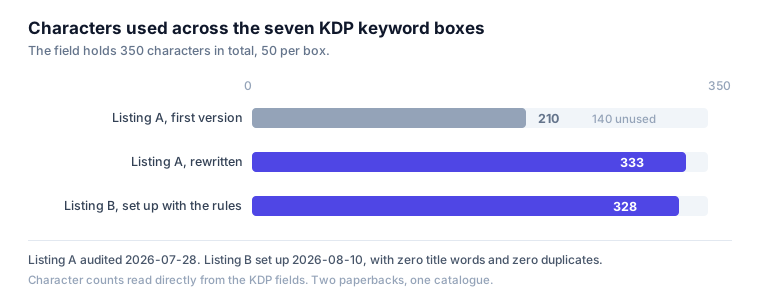
Amazon asks for up to seven keywords or short phrases, relevant to the book and arranged in a sensible order. It does not publish how the seven fields are stored, combined or weighted, and anyone who tells you otherwise is describing an inference. We work on the practical assumption that the box a word sits in does not matter much, so the useful question is about the set of words rather than their arrangement: how many distinct, relevant words are in there, and how many slots are spent on words that cannot add anything?
Measured that way, our answer on July 28, 2026 was uncomfortable. Half the available space was holding words that could not be doing any work, which is a different problem from having chosen the wrong words.
Rule one: no word that already appears in your title
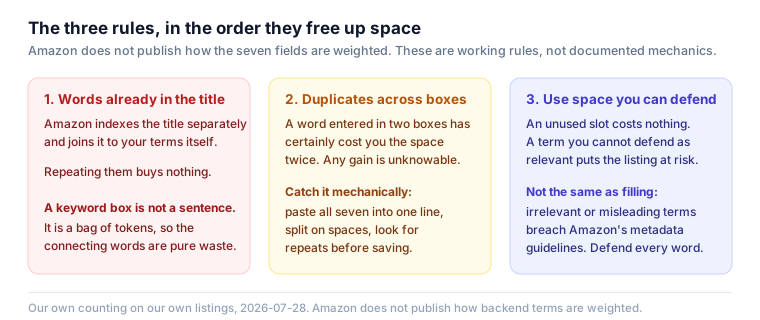
This is the rule with the largest effect and the one most often broken, because it feels wrong. Amazon indexes your title and subtitle separately, and joins them to your backend terms itself. If your title already contains the word word, adding word search to a keyword box spends five characters to tell Amazon something it knows.
The trap is writing keyword boxes as readable phrases. A keyword box is not a sentence, it is a bag of tokens. Supplying the one word that is missing is enough for the pairing to match; supplying the connecting words around it is pure waste. Every publisher we have compared notes with writes phrases at first, because phrases look tidier in the form.
Rule two: no word repeated from one box to another
Amazon asks publishers not to repeat metadata across fields, and a word entered in two boxes has certainly cost you the space twice. Whether it also gains you anything is unknowable from outside, which is precisely why deduplicating is the safe move: the downside is measurable and the upside is not. Duplicates creep in easily when the seven boxes are filled at different times, or when each box is built around a theme and the themes share vocabulary. The only reliable way to catch this is mechanical: paste the seven boxes into one line, split on spaces, and look for repeats before saving.
On the July audit, duplicates and title words together accounted for most of the difference between a set that looked full and a set that was genuinely full.
Rule three: use the space you have a real reason to use
This is the rule most easily misread, so let us be exact about what we are and are not claiming. Amazon nowhere says a fuller field ranks better. Going from 210 to 333 characters is a record of what we did, not evidence that 333 is superior; we have not measured a ranking effect and this audit could not have measured one.
What is defensible is narrower: if you have a relevant term that buyers genuinely use and it is not in your metadata anywhere, leaving it out cannot help you. In practice we found roughly forty-eight characters a comfortable working length per box — enough for two or three real phrases without fighting the field limit. If you cannot fill a box with terms you can defend, stop. Irrelevant or misleading terms breach Amazon’s guidance on keywords, and an empty slot costs you nothing while a bad one puts the listing at risk.
What to put in the space you just freed
Five sources produced nearly all of our usable terms.
- Synonyms the title does not cover. The title carries one phrasing; buyers use several.
- The other market's register. Our French listings sell into both France and Quebec, which do not use the same everyday words for the same relative. Supplying both is free.
- The buyer, not the reader. For a large-print puzzle book, the purchaser is often not the user. Gift vocabulary and the language of activity coordinators in retirement residences describe the person paying.
- The vocabulary of five-star reviews, on competing titles as much as your own. Buyers describe the benefit in words no author would choose.
- The book's real contents. Chapter themes and puzzle types are specific, defensible, and usually absent from the title.
An unexpected source: the advertising keyword tool
The most useful vocabulary source we found was not a keyword tool at all. In the Amazon Ads console, the Enter list tab of a campaign draft accepts pasted seed terms and returns a suggested bid for each one. You never have to launch the campaign to read the output.
Treat what it returns as a source of ideas, not as measurement. A suggested bid reflects what similar ads recently paid to win impressions; it is a sign the term has commercial activity around it, not a certified search volume for that exact phrase. And no bid returned does not mean an uncontested term — the ordinary explanation is that Amazon has too little data to propose a range at all. Both readings are worth harvesting and neither is worth trusting: take the terms, then validate them in Amazon’s own search box against autocomplete and the results it actually returns. The Suggested tab, by contrast, was useless on a book with no sales history: it returned broad category labels rather than search terms.
That is the pattern worth remembering. The highest-value backend term is frequently the one your title forgot, and you will not notice it by rereading your title. You notice it by pricing the vocabulary.
What backend keywords will not do for you
This is where most advice on the subject overpromises, so we will be plain. Backend keywords can help establish that a listing is relevant to a query. This audit did not measure ranking or discovery, and Amazon does not publish how any of it is weighted. Anyone quoting you a formula is inventing it.
Backend keywords open the long tail. They make you findable on the specific, low-volume phrasings that nobody is fighting over, which is a genuine and repeatable gain. They do not win a contested term. Any guide promising that a keyword rewrite will lift you against established competitors is describing a mechanism that does not exist.
The audit, as a repeatable procedure
- Copy the seven boxes into one line and count the characters. That number is your baseline.
- List every word from your title and subtitle, then delete each one where it appears in the boxes.
- Sort the remaining words and delete duplicates across boxes.
- Refill from the five sources above with terms you can defend, up to around forty-eight characters where the vocabulary genuinely exists.
- Check every added word against the book's real content before saving.
- Record the date and the character count, so the next audit has something to compare against.
Roughly twenty minutes a listing, no cost, and unlike a price change it does not touch your margin. Speaking of which, the relationship between price, page count and what you actually keep is set out in our note on KDP print costs and royalties.
Scope and limits of this audit
These figures come from two paperbacks in one catalogue, audited on July 28 and August 10, 2026. Both are puzzle books, one in French and one in English, which is a narrow slice of KDP and may not generalise to fiction or to long-form non-fiction. The character counts are exact because they were counted directly in the fields; the claim that the rewrite improves discovery is not established here, and we have deliberately not asserted it. Amazon does not publish how backend terms are weighted, so the three rules above are inferences from documented behaviour and from our own counting, not from any statement by Amazon. The one thing this report does establish is the gap between a keyword set that looks complete and one that is measured as complete.