How to Check if a KDP Book Sold: What Sales Rank Can and Cannot Prove
We spent part of a month believing two sales had gone missing. They had not. The confusion came from treating four different reporting channels as if they were one, each with its own delay running from about 1 hour to roughly 60 days. The fastest of the four does not require logging in to anything — but it is a one-way instrument, and reading it backwards is how we lost the weeks.
A sales rank means at least one sale, but no rank means nothing
A book on Amazon has no Best Sellers Rank until it has sold at least one copy on that particular marketplace. The rank is not assigned at publication and it is not assigned when the listing goes live. It appears after a sale.
That makes the rank a reliable signal in exactly one direction. If a rank is present, a copy has sold on that marketplace. If no rank is present, you have learned nothing conclusive, and this is the half most publishers get wrong — including us. Amazon's own guidance says a sales rank can take 24 to 48 hours to appear after a completed order, so a freshly sold book can sit there looking exactly like a book that has never sold. Add a category change, a marketplace whose page you cannot parse, or a listing still propagating, and the absence has several possible causes.
Read it as a positive test with no negative result: presence proves a sale, absence defers the question to your Orders report. Checked against Amazon's published reporting timelines on August 26, 2026.
Why the sales rank is still the fastest way to check if a book sold
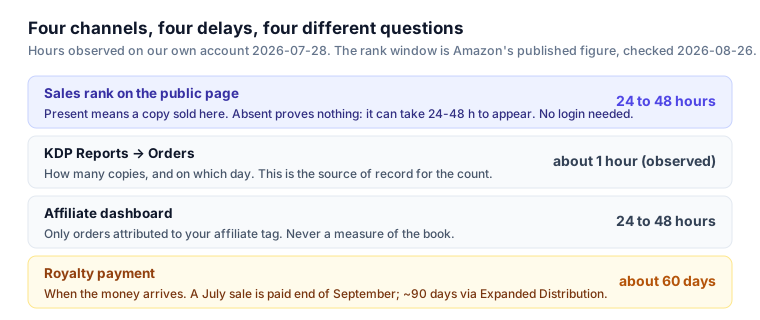
The other three channels each answer a slightly different question, which is precisely why they get confused with one another. Rank answers did a copy sell here. The dashboard answers how many, and when. The affiliate report answers did my own promotion cause it. The royalty statement answers when do I get paid. Asking rank for a payment date, or a royalty statement for today's sales, produces an answer that feels like bad news but is simply the wrong instrument.
Channel two: KDP Reports is the only source of a real count
Inside KDP, under Reports, the sales dashboard is where the actual number lives. On our own account on July 28, 2026, sales appeared there within roughly 1 hour — far from the weeks that publishers commonly assume. That is our observation on our own paperbacks, not a commitment: Amazon's help notes that an order can take longer to surface depending on format, so treat one hour as a typical case rather than a deadline.
The authoritative view is Reports → Orders → Lifetime, not the summary graph. That is the channel to use for counting, because rank only tells you a sale exists somewhere, while Orders tells you how many and on which day — which is what you need when you are trying to work out whether a price change or a new cover did anything. See Amazon's page on viewing orders and royalties.
Channel three: the affiliate dashboard, at 24 to 48 hours
If you run an author site with affiliate buy buttons, that dashboard is a fourth view and a narrow one. It reports only the clicks and orders attributed to your own affiliate tag, and on our account those took 24 to 48 hours to appear when we checked on July 28, 2026. A reader who searched Amazon directly and bought your book will never appear there, because nothing attributed the order to your link.
Treating this as a sales report understates your sales, sometimes to zero. It is a measurement of your own funnel, not of your book. On our own author site the affiliate dashboard has never come close to matching the catalogue, because most buyers arrive through Amazon search rather than through anything we published.
Channel four: royalties arrive around sixty days later
Royalties are paid approximately sixty days after the end of the month in which the sale occurred, once your payment threshold is met. A sale in July is paid at the end of September. Sales made through Expanded Distribution run roughly ninety days rather than sixty. This is the two-month delay publishers remember correctly and then apply incorrectly to visibility. Amazon sets out the schedule on its payment timing page.
The delay is real and it applies to the money. It does not apply to knowing.
What each channel can prove, and what it cannot
| Channel | What it proves | What it cannot prove |
|---|---|---|
| Public sales rank | At least one copy sold on that marketplace | That no copy sold. Absence is inconclusive for 24 to 48 hours, and longer if a parser or a category change is involved. |
| KDP Reports → Orders | The number of copies and the date. This is the source of record. | Instant certainty. An order can take longer to surface depending on format. |
| Affiliate dashboard | Which orders were attributed to your affiliate tag | Anything about total sales. Untagged buyers are invisible here. |
| Payments report | Money actually released to you | Recent activity. It runs about 60 days behind, and about 90 for Expanded Distribution. |
The mistake we actually made
Both halves of this went wrong at once, in opposite directions, which is what makes it worth reporting rather than a simple slip.
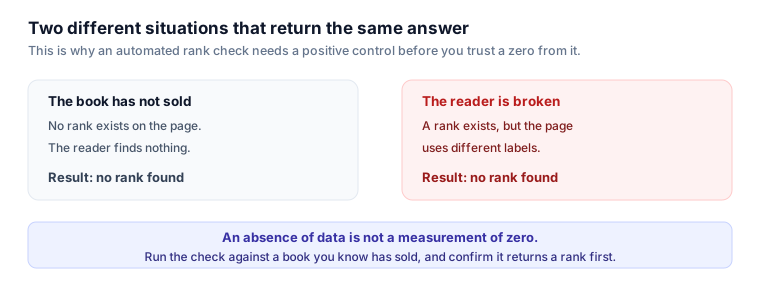
One of us assumed two July sales would only be reported two months later, and so stopped checking. Meanwhile the automated check we were running reported zero sales, because the script that read the rank had been written against English-language product pages. On the French marketplace the product details section uses different labels, so the parser found nothing and returned an absence, which was then read as a zero.
Using a sales rank without over-reading it
Rank is excellent at the binary question and unreliable for almost everything else. It is recalculated frequently and is relative to whatever else is selling at that moment, so a single low number can reflect one copy sold during a quiet hour rather than sustained demand.
It is also not comparable between marketplaces. A rank on one Amazon site is calculated against that site's catalogue and traffic and cannot be set beside a rank from another, which is a trap we cover separately in our note on Amazon.ca versus Amazon.com for KDP research. Use rank to establish that a sale happened, and the dashboard to establish how many.
Rank movement over time is more informative than any single reading. A rank that reappears every few days indicates a title selling on a rhythm; a rank that appeared once and drifted steadily upward for weeks indicates one sale and nothing since.
What this looks like across a real catalogue
Applied to our own titles, this method gave an uncomfortable but useful picture. As of August 4, 2026, one title was selling on a genuine rhythm, roughly every four to seven days, entirely from organic search with no advertising running. For the remaining English-language titles, no visible rank was found during that check, so the public page could not confirm a sale either way. The count itself came from the Orders report, which is the only place it can come from.
That distinction changed what we worked on. Slow sales would have been a pricing or cover problem. Very few sales, on titles that are indexed and live, is a discovery problem, and it pointed the work toward listings and keywords rather than toward producing more books.
A five-minute check you can run today
- Open the public product page on the marketplace you care about. A private window simply gives you a neutral view of the listing; it does not change the rank.
- Scroll to the product details and look for a Best Sellers Rank. Present means at least one sale there. Absent means unconfirmed, not zero — wait out the 24 to 48 hour window before drawing anything from it.
- Repeat per marketplace. Each one is independent, and a book can have sold on one and not another.
- For counts and dates, open Reports → Orders → Lifetime in KDP. That is the number of record; on our account it was current within roughly an hour.
- Do not look for the money yet. That is the sixty-day channel and it is not evidence of anything today.
- If you automate step two, first run it against a book you know has sold, and confirm it returns a rank.
Scope and limits of this method
Two kinds of statement appear above and they should not be read the same way. The one-hour dashboard figure and the 24 to 48 hour affiliate figure are our own observations, made on July 28, 2026, on our own KDP account, on the Canadian and United States marketplaces, for paperbacks. They are not commitments and they may not match your account. The 24 to 48 hour rank window, the possibility of longer order reporting, and the sixty and ninety day payment schedules come from Amazon’s published help pages, linked above and checked on August 26, 2026; Amazon changes those pages, so verify before relying on them. This report does not establish how sales rank is calculated, only that its presence follows a completed sale; nor does it address ebook or Kindle Unlimited reporting, which we have not measured. What it does establish is that the two-month delay belongs to payment alone, and that a missing rank is a question rather than an answer.