KDP Low Content vs High Content: What Page Count Does to Printing Cost
The low content versus high content argument is usually framed as a question of effort or of ethics. On the printing invoice it is neither. Amazon charges the same way for both, by the page, so the only thing that separates a puzzle book from a novel in cost terms is how many pages it has — and that single number sets both the floor under your costs and the ceiling over your price.
What low content and high content actually mean
The vocabulary is not Amazon’s. Publishers use low content for books whose interior is largely structural — journals, planners, logbooks, puzzle grids, colouring pages — and high content for books read for their text. KDP itself does not offer this as a category, does not price by it, and does not gate anything behind it. There is no low content button.
That matters more than it sounds. Because the distinction has no mechanical existence inside KDP, every decision people attribute to it is really a decision about something else: page count, trim size, ink, category, or the promise made on the cover.
KDP prints both by the same per-page formula
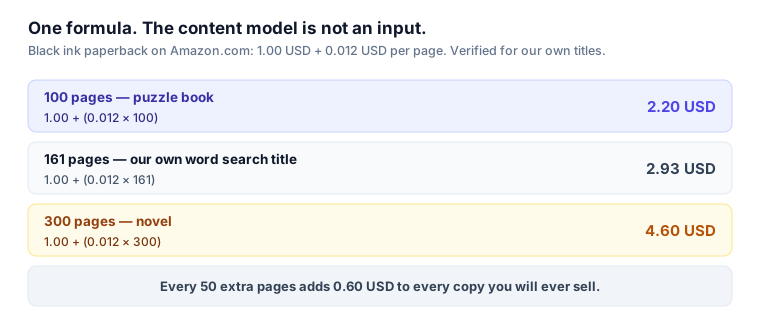
A black ink paperback sold on Amazon.com costs a fixed amount plus a per-page amount. At the rates we verified for our own titles, that is 1.00 USD plus 0.012 USD for each page. The formula does not ask what is printed on those pages.
A 300-page novel: 1.00 + (0.012 × 300) = 4.60 USD
Same ink, same trim, same formula. The only variable is page count.
So the widespread belief that low content books are cheaper to produce is true, but not for the reason usually given. They are not cheaper because they are simpler. They are cheaper because they are shorter, and a high content book of the same length would cost exactly the same to print.
Why page count is the number that decides everything
Once printing is a function of length alone, the strategic question stops being which model should I publish and becomes how many pages can this book justify. A book that is too short has almost no cost, and also almost no perceived value on a product page sitting next to thicker competitors. A book that is too long carries a cost floor that quietly eats the royalty on every copy, forever.
The high content trap: length you cannot charge for
Long books are where this bites hardest, because the cost is permanent and invisible. At 0.012 USD a page, an extra fifty pages adds 0.60 USD to every single copy you will ever sell. If those fifty pages do not let you raise the price, you have not added value; you have bought yourself a smaller royalty in perpetuity.
This is the honest argument against padding a manuscript to look substantial. It is not that readers notice. It is that the printer charges you for it on every copy, and the price the market will bear does not move just because the spine got thicker.
The low content trap: a page count nobody wants to pay for
The opposite failure is just as expensive and harder to see. A very thin book is cheap to print and difficult to price, because a buyer comparing two puzzle books compares what they get. Cutting pages to protect a margin can cost you the sale entirely, which is a worse outcome than a thinner margin on a sale that happened.
We have a measurement on exactly this. One of our puzzle titles ran 161 pages at 6×9. Rebuilding the same content at a larger trim brought it down to 136 pages, and the arithmetic said we would save 0.28 CAD per copy. A genuine saving, and it turned out to be the wrong thing to optimise.
What a trim size change cost us in practice
Changing trim size on a live KDP paperback does not edit the book. It creates a new one, with a new ASIN, and the original listing keeps whatever history it had accumulated. We covered the mechanics of that in our note on what changing trim size actually creates.
Where the real difference between the two models sits
If printing does not distinguish them, something must, and it does — just not where the debate usually puts it. The genuine differences are in what happens after the file is uploaded.
- Category fit. Structural books sit in crowded, weakly differentiated categories where the cover does most of the work.
- Review accumulation. Books that are used rather than read attract fewer reviews per copy sold. Across 11 published titles we had 0 customer reviews, which is a discovery problem no printing decision can fix.
- Metadata surface. A text-heavy book gives Amazon far more to index from than a book of grids does.
- Reusability. A structural interior can be rebuilt for a new theme; a manuscript cannot.
How to choose, using the numbers rather than the label
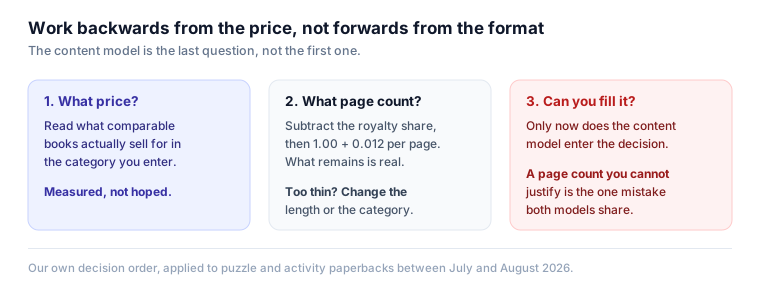
Work backwards from the price, not forwards from the format. Find what comparable books actually sell for in the category you are entering. Subtract the royalty share, then the printing cost for the length you are considering. What remains is your real royalty, and if it is too thin the answer is a different page count or a different category — not a different label for the same book.
Only then ask whether you can fill that length honestly. A page count you cannot justify with real content is the one decision that is wrong under both models.
Scope and limits
The printing formula quoted here is the black ink paperback rate for books sold on Amazon.com, verified against KDP’s published cost pages for our own titles; rates differ by marketplace, by ink, and by trim, and Amazon changes them. The page counts, the 0.28 CAD figure and the review count are measurements from our own catalogue between July 14 and August 5, 2026, on puzzle and activity paperbacks — a narrow slice of publishing, and they may not generalise to yours. This article does not measure sales, ranking or discovery under either model, and nothing here should be read as a claim that one model sells better than the other. What it does establish is that the cost side of the argument is settled by page count alone.